

RCH Achieves AWS Life Sciences Competency
Leading Cloud solutions exclusively for Life Sciences teams that accelerate discovery, optimize costs and ensure scalability and compliance in AWS.



Leading Cloud solutions exclusively for Life Sciences teams that accelerate discovery, optimize costs and ensure scalability and compliance in AWS.
About the whitepaper:
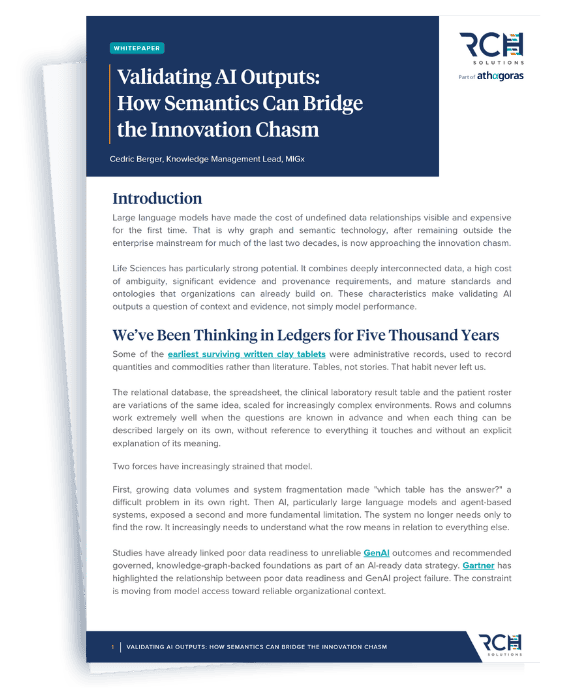
AI can generate convincing answers in seconds. But in Life Sciences, validating AI outputs requires more than a plausible response. Teams need to understand which evidence supports a conclusion, how information connects, and whether the right definitions and rules were applied.
As AI becomes more embedded in R&D, Clinical, and regulatory workflows, missing context can make answers difficult to verify. Semantic technologies, including knowledge graphs, offer ways to connect data, definitions, and evidence, helping organizations build a stronger foundation for reliable AI.
This whitepaper, written by Cedric Berger, Knowledge Management Lead at MIGx, explores why semantic technology is gaining relevance, where structured relationships add value beyond conventional AI retrieval methods, and how Life Sciences organizations can approach AI validation through practical, traceable workflows.
Validating AI outputs is becoming an important challenge for Life Sciences organizations. Artificial intelligence can generate convincing answers in seconds, but can it demonstrate which evidence supports a conclusion, how information connects, and whether the correct definitions and rules were applied?
Across R&D, Clinical, and regulatory workflows, AI-generated insights may draw on information from multiple systems, disciplines, and sources. Evaluating these outputs requires more than determining whether an answer sounds plausible.
Large language models are effective at processing language and generating responses. However, producing a convincing answer is not the same as establishing that the supporting information is appropriate and correct.
Consider a clinical study. Information about the same study may appear differently across research databases, clinical systems, and regulatory documentation. Without clear connections between these records, an AI system may struggle to determine which information applies to a specific question.
As organizations introduce more sophisticated AI workflows, connecting model capabilities with trusted organizational information, established procedures, and authoritative sources becomes increasingly important.
Humans can often resolve conflicting terminology through discussion and experience. Machines working across enterprise systems may need more explicit information.
This includes the identity of an entity, its relationships to other entities, where supporting information originated, and which rules apply to its interpretation.
Without that structure, validating AI-generated outputs becomes difficult, particularly when conclusions depend on information distributed across multiple systems.
Semantic technologies, including ontologies and knowledge graphs, provide ways to represent relationships between information explicitly.
Rather than treating each document or data point independently, these approaches can connect scientific concepts, evidence, classifications, and sources.
This builds on the broader role of Knowledge Management in Life Sciences, where making information accessible, traceable, and reusable helps teams collaborate and make informed decisions.
Not every AI application needs a knowledge graph.
For straightforward information retrieval, conventional retrieval-augmented generation (RAG) may be sufficient.
Semantic approaches become more valuable when answering a question requires resolving identities across systems, following multiple relationships, tracking provenance, or applying complex rules.
Selecting the right approach depends on the workflow's requirements. The broader architecture of GenAI solutions must also account for data handling, security, scalability, and governance.
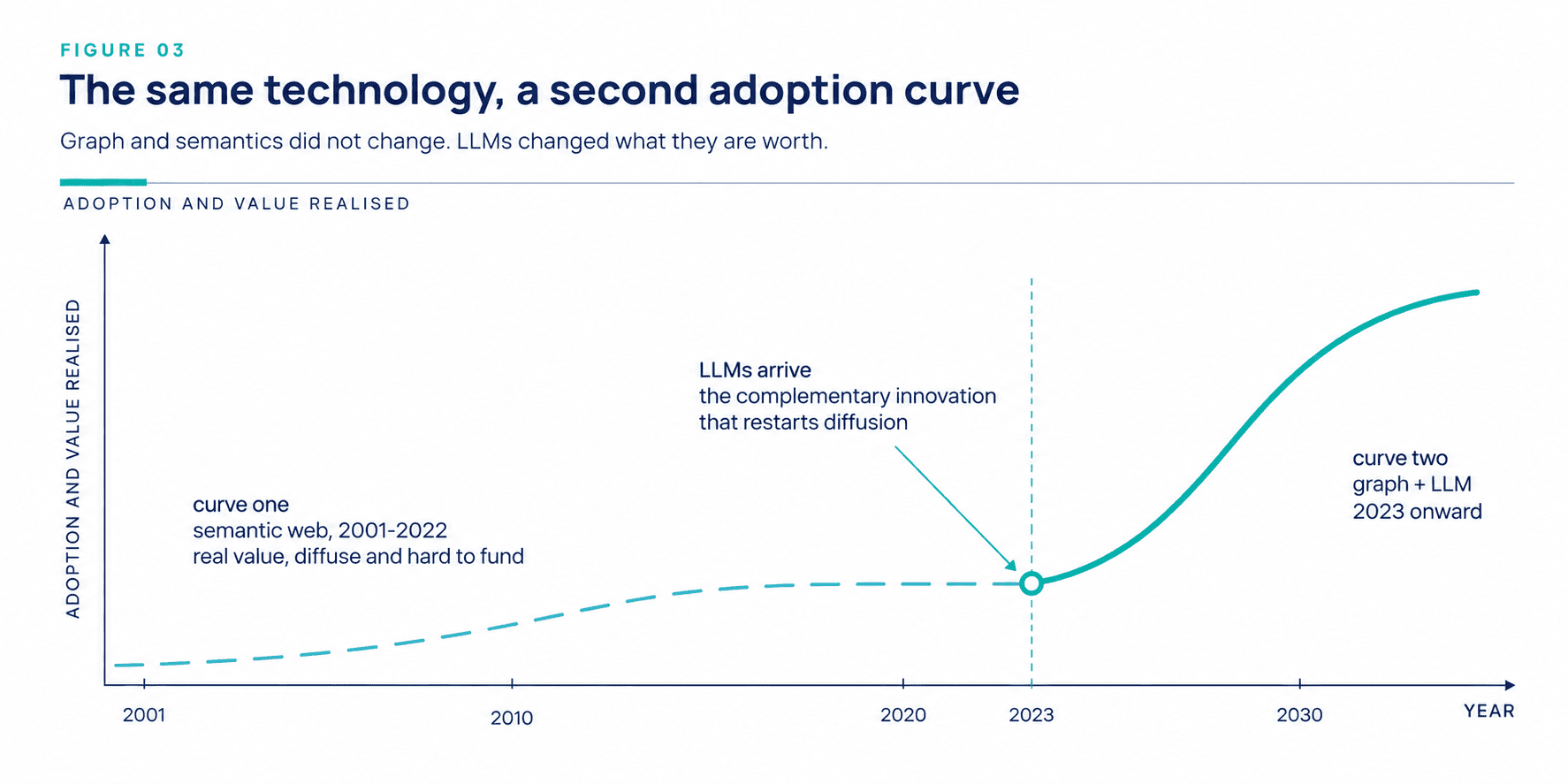
Life Sciences presents a particularly relevant environment for relationship-based technologies. Scientific information is deeply interconnected, terminology differs across departments, and decisions often depend on evidence that must remain accessible and understandable over time.
Effective data management helps organizations maintain the quality, accessibility, and governance of this information. Semantic relationships can add another layer by making connections between data, definitions, and decisions more explicit.
Consider an AI-supported regulatory submission or label amendment.
To evaluate the conclusion, a team may need to establish:
Structured relationships can help connect these elements, making the reasoning behind a conclusion easier to examine.
This is an important distinction when validating AI outputs. Traceability does not guarantee accuracy, but it provides a stronger foundation for reviewing, questioning, and understanding an AI-supported decision.
The opportunity for Life Sciences organizations is not to introduce semantic technology everywhere. It is to identify specific workflows where incomplete context limits the reliability or usefulness of AI.
At RCH Solutions, together with MIGx, we combine scientific computing, Knowledge Management, data governance, and GenAI expertise to help organizations strengthen the foundations supporting AI across R&D, Clinical, and Bio-IT.
By starting with clearly defined challenges, such as decision traceability or complex scientific data integration, organizations can evaluate where structured knowledge provides meaningful value.
Cedric's full whitepaper examines the wider argument behind validating AI outputs, including the changing economics of semantic technology, real Life Sciences implementations, and practical applications of knowledge graphs.
Validating AI outputs means assessing whether generated responses are appropriate and supported by relevant evidence. In Life Sciences, this may require examining the sources, definitions, relationships, and rules behind an answer.
Research, clinical, and regulatory systems may use different terminology, classifications, and identifiers. Without sufficient context, AI systems can struggle to interpret how information connects or whether records refer to the same entity.
Knowledge graphs can be valuable when a workflow involves complex relationships, entity resolution, evidence provenance, or multi-step reasoning. Simpler document retrieval applications may not need them.
Semantic relationships can connect studies, data points, rules, definitions, and prior decisions, helping teams reconstruct and review the evidence behind AI-supported conclusions.
Start with a well-defined workflow where AI-generated answers are difficult to verify. Identify the required evidence, relationships, and governance needs before selecting an appropriate technical approach.